Designing for Focus: Acoustic Solutions for Singapore’s Open-Plan Offices

Designing for Focus: Acoustic Solutions for Singapore’s Open-Plan Offices
The open-plan office was originally championed as the ultimate tool for corporate collaboration. However, for many businesses in Singapore, it has inadvertently become the ultimate tool for distraction. As teams return to the CBD in 2026 for hybrid work schedules, the stark contrast between the quiet focus of a home office and the loud, echoing reality of an open floor plan is jarring.
Noise is consistently ranked as the number one complaint among corporate employees, leading to decreased productivity, heightened stress, and a reluctance to return to the office.
At Skai Atelier, we do not believe the solution is reverting to isolated, claustrophobic cubicles. Instead, we use strategic interior design and advanced acoustic treatments to create a balanced acoustic landscape. Here is how we design for focus in the modern open-plan office.
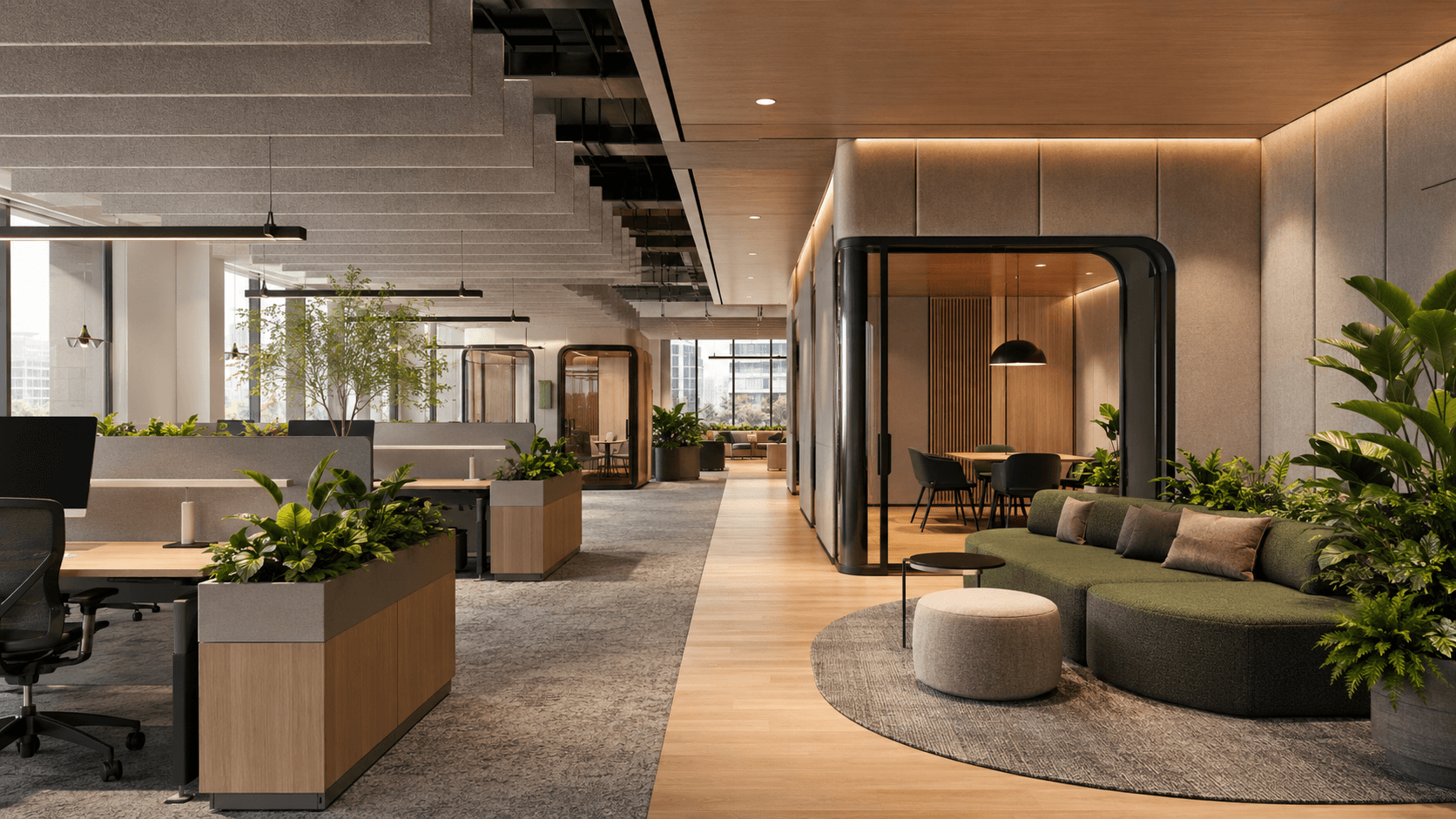
1. The Ceiling Strategy: Baffles and Clouds
In most commercial spaces, the ceiling represents the largest uninterrupted surface area for sound to bounce off. Leaving exposed concrete ceilings might look trendy and industrial, but it creates an acoustic nightmare.
Suspended Acoustic Baffles: We install vertically suspended panels made from high-density, sound-absorbing PET felt. These baffles catch and trap sound waves before they can travel across the room.
Acoustic Clouds: For a softer aesthetic, horizontal acoustic "clouds" can be suspended directly above high-noise areas like the collaborative desks or the pantry, effectively capping the noise at the source while doubling as striking architectural features.
2. Zoning for Sound: The "Library" vs. The "Hub"
Effective acoustic design is just as much about spatial planning as it is about materials. We utilize Activity-Based Working (ABW) principles to physically separate conflicting work styles.
The Active Hub: Position the cafe-style pantry, brainstorming whiteboards, and collaborative tables at one end of the floor plate.
The Deep Focus Zone: At the opposite end, create a "Library Zone." This area is governed by library rules—no phone calls, no loud conversations. We separate these two distinct zones using transitional buffer spaces, such as meeting rooms or storage banks, to block sound transmission.
3. Micro-Architecture: Phone Booths and Focus Pods
When an employee needs to take a confidential client call or dive into a complex spreadsheet, they need immediate, on-demand privacy without occupying a 10-person boardroom.
Acoustic Phone Booths: These freestanding, soundproof glass pods are essential for modern offices. They provide high acoustic isolation (typically dropping noise by 30 decibels) and come equipped with integrated ventilation and power.
Semi-Enclosed Banquettes: For quick, two-person huddles, we design high-backed, fabric-upholstered booth seating. The high, padded walls act as a localized acoustic shield, preventing the conversation from bleeding into the surrounding desks.
4. Biophilic Sound Diffusers
Your office greenery can do more than just purify the air and look beautiful—it can actively manage noise.
Tropical Plant Barriers: Sound waves bounce harshly off flat, hard surfaces like glass and drywall. The complex, irregular surface area of broadleaf tropical plants—such as large Monsteras, Ficus trees, or a dense living wall—acts as a natural sound diffuser. By scattering the sound waves, indoor greenery significantly reduces the harsh reverberation and echo within an open-plan room.
5. Softening the Floor and Walls
Every hard surface in an office is a trampoline for noise. Softening the architecture is a critical step in sound absorption.
Commercial Carpet Tiles vs. Concrete: While polished concrete floors are visually striking, they amplify the sound of every footstep and dropped pen. High-quality commercial carpet tiles with acoustic backing provide a massive reduction in impact noise. If you prefer hard floors, utilizing luxury vinyl flooring (LVF) offers a softer, quieter alternative to ceramic tile or concrete.
Textured Wall Coverings: We wrap strategic structural pillars and blank walls in textured, acoustic fabrics or fluted timber panels with an acoustic felt backing. This prevents sound from endlessly ricocheting between parallel walls.
About the Author
This article was written by the team at Skai Atelier, an interior design studio specialising in cafe renovation Singapore, F&B interior design, and commercial renovation Singapore projects.
FAQ: Café Renovation Cost Singapore
1. What is the difference between soundproofing and sound absorption?
Soundproofing is about blocking noise from entering or leaving a room (e.g., building a solid wall to stop boardroom conversations from being heard outside). Sound absorption is about reducing the echo and reverberation within a room (e.g., using acoustic baffles so the open-plan desk area does not sound like a noisy cavern). A well-designed office requires both.
2. Do acoustic panels ruin the aesthetic of a modern office?
Not at all. Gone are the days of ugly, egg-carton foam. Modern acoustic treatments are highly customizable design features. We use beautifully shaped felt baffles, custom-printed acoustic wall fabrics, and slatted timber panels that look like high-end architectural finishes while secretly absorbing sound.
3. How much do acoustic phone booths cost in Singapore?
Prices vary based on size and acoustic rating. In 2026, a high-quality, single-person acoustic phone booth typically ranges from $5,000 to $8,000. Larger, 4-person meeting pods can range from $12,000 to $20,000. While it is an upfront investment, it is often much cheaper and faster than building traditional, fixed meeting rooms that require new air-conditioning and sprinkler routing.
4. Will adding plants actually make the office quieter?
Yes. While plants do not "block" sound like a solid wall, their varied leaf structures are excellent at sound diffusion. They break up the flat surfaces of an office, scattering the sound waves and reducing the overall harshness and echo in the room, making the ambient noise much more comfortable.
5. Do we need building management approval to install acoustic ceiling baffles?
5. Do we need building management approval to install acoustic ceiling baffles?
6. How do I get an initial quote for my project?
The best way is to Book a Discovery Call through our website. During this session, we discuss your budget, functional requirements, and design preferences to provide a transparent and comprehensive preliminary estimate.